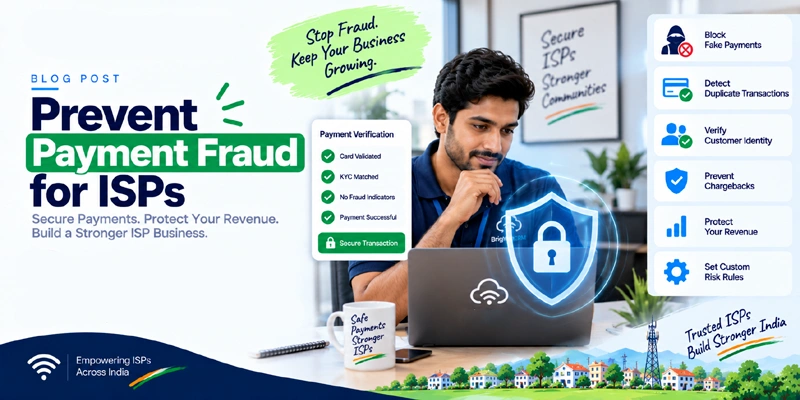
Payment Fraud Isn't Just One Problem
When ISPs think about payment fraud, field collection skimming usually comes to mind first — an agent collecting cash and reporting less than what was actually paid. That's real and worth solving (we've covered GPS-tracked collection for exactly this in a separate guide). But it's only one of several fraud vectors that can quietly drain revenue if your systems don't account for them.
The Different Types of Payment Fraud ISPs Actually Face
- Field collection skimming: Cash collected but under-reported or not deposited, discussed in depth in our guide on GPS-tracked collections
- Fake payment proof: A customer (or occasionally staff) claims a payment was made and shows a screenshot that's edited, outdated, or from a failed transaction — hard to catch without a proper verification system
- Unauthorized waivers and discounts: Staff quietly waiving late fees or granting undocumented discounts, sometimes as a favor, sometimes for personal gain
- Backdated or duplicate receipts: A receipt manually altered or reissued to cover a discrepancy, especially in manual, paper-based billing systems
- Chargeback and failed-transaction disputes: A customer disputes a card payment after receiving service, or claims a failed UPI transaction actually succeeded
💡 The Common Thread
Every one of these fraud types thrives in the gap between "what someone claims happened" and "what your system can actually verify happened." Closing that gap — not just watching field staff more closely — is what actually prevents fraud.
Why Cash-Heavy Collection Makes This Worse
Every fraud type above becomes easier when cash is involved, because cash has no built-in verification trail the way a digital transaction does. This is why the single most effective fraud-prevention step for many ISPs isn't a new control — it's simply shifting as much collection as possible to UPI, cards, and net banking, which are independently verifiable at the payment gateway level regardless of what any individual claims.
Prevention Strategy 1: Verify Payment Proof Programmatically, Not by Screenshot
A screenshot is trivially easy to fake or misrepresent. A payment confirmed directly through your payment gateway's API or webhook — showing the actual transaction status, amount, and timestamp — isn't. Whenever possible, treat "payment received" as a status your billing system confirms automatically from the gateway, not something a customer or staff member reports and you take on faith.
Prevention Strategy 2: GPS-Tag and Digitally Receipt Any Remaining Cash Collection
For collections that still happen in cash, location-tagging each transaction and issuing an instant digital receipt to the customer closes the field-skimming gap — since the customer has independent proof of what they actually paid, separate from whatever the agent reports. We cover this specific control in detail in our guide on GPS-tracked field collections.
Prevention Strategy 3: Restrict Who Can Approve Waivers and Discounts
Undocumented waivers are an internal control problem, not a field problem. The fix is role-based permissions: front-line staff shouldn't be able to unilaterally waive fees or apply discounts without the action being logged and, above a certain threshold, requiring a manager's approval within the system itself — not a verbal okay that leaves no record.
Prevention Strategy 4: Automated Reconciliation and Anomaly Alerts
Your billing system should automatically flag mismatches — collected amounts that don't match deposited amounts, an unusually high rate of "customer not home" outcomes from one specific agent, or a spike in manually-applied discounts from one login. Catching these patterns automatically is far more reliable than hoping someone notices during a manual review weeks later.
Prevention Strategy 5: Random Spot Audits and Customer Verification Calls
Periodically call a random sample of customers marked as "visited but not paid" or "given a discount" to confirm the recorded outcome actually matches what the customer experienced. Knowing this check happens occasionally is itself a meaningful deterrent, even before any specific issue is found.
Prevention Strategy 6: Make Digital the Default, Not the Exception
Every payment that moves from cash to UPI, card, or net banking is one less transaction that depends on trusting a person's report of what happened. This doesn't just reduce fraud risk — it also reduces the operational overhead of investigating disputes in the first place.
How BrightCRM Helps Close These Gaps
- Direct payment gateway integration confirms transactions programmatically rather than relying on submitted proof
- GPS-tagged field collection with instant digital receipts for any cash still collected in person
- Role-based permissions so discounts and waivers require the right level of approval, logged automatically
- Reconciliation reports that surface mismatches and unusual patterns without manual digging
Real-World Impact
Broadband ISP, Jamshedpur
"We didn't realize how much was slipping through undocumented 'goodwill' waivers until we required manager approval in the system. That alone tightened things up significantly."
Cable Operator, Bhilai
"Moving most customers to UPI removed the majority of our fraud exposure without us having to police anyone more closely — there was simply less cash in the system to lose track of."
Conclusion: Reduce the Surface Area, Not Just the Suspicion
You don't need to treat your field staff as suspects to prevent payment fraud — you need systems that don't depend on trust in the first place. Verified digital payments, logged approvals, and automatic reconciliation close most of the gaps fraud relies on, while still respecting the honest majority of your team who were never the problem to begin with.
Ready to Close the Gaps Fraud Depends On?
See how BrightCRM's verified payments, GPS collection, and reconciliation reports work together.
Schedule Free Demo