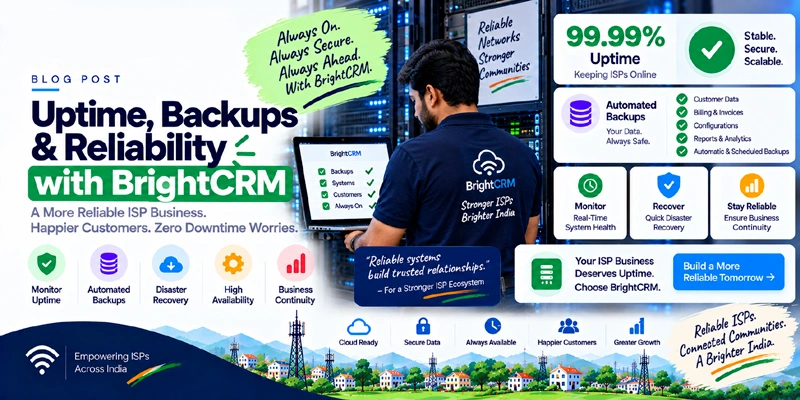
Why Uptime Matters More for Billing Than It Might Seem
A website going down for ten minutes is an inconvenience. Billing software going down during a peak collection period is different — it means payments can't be processed, customers can't be reactivated after paying, and your support team gets flooded with "why isn't this working" calls at the worst possible time. For an ISP, billing software isn't a nice-to-have dashboard; it's the system that determines whether your customers' internet stays on.
What "100% Uptime" Actually Means in Practice
Worth being upfront about: no software system anywhere achieves literal, mathematically perfect 100% uptime forever — every system needs occasional maintenance, and hardware and networks can fail unexpectedly. When a vendor says "100% uptime," it's best understood as a strong reliability commitment and design goal, not a literal guarantee that nothing will ever interrupt service for a single second, ever. What actually matters is how rare, how brief, and how well-communicated any interruption is — and what happens to your data and operations if one occurs.
What Actually Delivers High Reliability
- Redundant infrastructure: Running on servers/systems designed so that one failure doesn't take the whole platform down
- Automated monitoring: Systems that detect a problem and alert the team (or self-correct) before customers even notice
- Load handling for peak periods: Billing platforms see their heaviest traffic right around common due dates — the system needs to handle that spike without slowing down or failing
- Planned maintenance communication: Any necessary downtime for upgrades should be scheduled during low-usage hours and communicated in advance, not sprung on customers
Why Daily Backups Matter Just as Much as Uptime
Uptime keeps the system running; backups protect you if something still goes wrong. Automatic daily backups mean that even in a worst-case scenario — server failure, accidental data deletion, a bad update — you lose at most a day's worth of data, not months of billing history and subscriber records built up over years.
💡 The Question That Actually Matters
It's not just "do you have backups?" — it's "have those backups actually been tested to confirm they restore correctly?" A backup that's never been tested is an assumption, not a safety net.
The Cost of Downtime for an ISP Specifically
- Blocked payments: Customers trying to pay during an outage simply can't, delaying your cash flow
- Failed activations: A customer who paid but can't get reconnected because the system linking payment to RADIUS is down generates immediate frustration and support calls
- Support overload: Every minute of downtime during peak billing periods can generate a disproportionate spike in "is something wrong?" calls
- Trust erosion: Customers extend some patience for network issues on your side, but far less for "the billing app isn't working" — it reads as unprofessional even when the cause is a third-party software issue
Questions Worth Asking Any Billing Software Vendor
- What's your actual historical uptime, not just the target?
- How is planned maintenance scheduled and communicated?
- How often are backups taken, and have restorations actually been tested?
- What's the process if an outage does happen — how are customers/ISPs like you notified, and how quickly is it typically resolved?
A vendor confident in their reliability should answer these directly rather than pointing only to a marketing claim.
What BrightCRM Commits To
BrightCRM's published commitment includes automatic daily backups and a strong uptime target for the platform your billing and subscriber management runs on. As with any vendor, if uptime history or specific reliability documentation matters for your own planning, it's reasonable to ask for that detail directly rather than relying only on the headline claim — a standard due-diligence step regardless of which billing software you're evaluating.
Conclusion: Reliability Is a Practice, Not Just a Promise
A percentage on a website is a starting point for the conversation, not the end of it. What actually protects your business is redundant infrastructure, tested backups, and a vendor that's transparent about what happens when — not if — something eventually needs fixing.
Want the Details Behind Our Reliability Commitment?
Ask us directly during a demo about our infrastructure, backup process, and uptime track record.
Schedule Free Demo