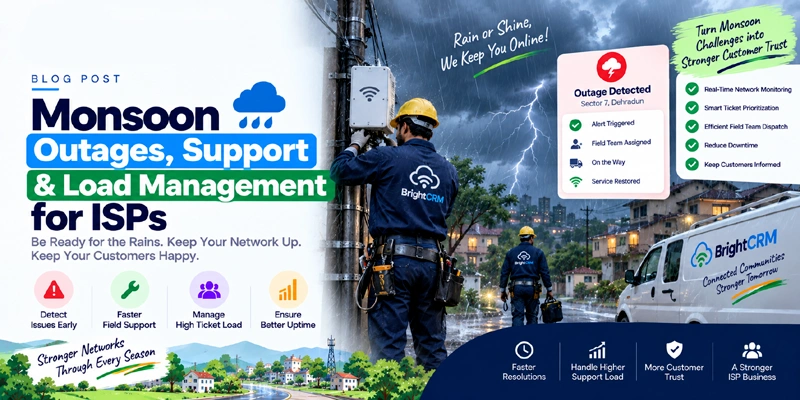
Why Monsoon Season Hits ISPs Especially Hard
Broadband infrastructure is physically exposed in ways that make monsoon season uniquely disruptive: overhead cables sway and snap in heavy wind and rain, underground ducts flood and damage buried fiber, road digging and waterlogging cause accidental cable cuts, and power outages during storms take down network equipment even when the cable itself is fine. A single incident — one cut line, one flooded junction box — can knock out service to an entire neighborhood at once.
The Real Problem Isn't the Outage — It's the Complaint Flood
Your network team can typically only fix one physical problem at a time regardless of how many people are affected. But your support line doesn't know that — it just gets 150 individual calls about what is actually one single incident. Every one of those calls takes staff time to answer, log, and explain, time that would be far better spent coordinating the actual repair.
💡 The Core Insight
One outage, handled reactively, generates hundreds of individual support interactions. The same outage, communicated proactively, generates far fewer — because customers already know what's happening before they think to call.
Strategy 1: Communicate Before the Calls Start
The moment your network team confirms an area-wide outage, send an automated SMS/WhatsApp alert to affected customers: what's happened, the approximate area affected, and an expected resolution window if you have one. Most customers who receive this proactively won't bother calling — they already have the answer they were going to ask for.
Strategy 2: Group Complaints by Incident, Not Just by Customer
When complaints do come in, tag them against a known outage incident rather than logging each as an unrelated, individual ticket. This does two things: it stops your team from investigating the same root cause 150 separate times, and it lets you close all related tickets at once with a single resolution update once the fix is done.
Strategy 3: Let Customers Check Status Themselves
A self-service portal or a simple WhatsApp status check ("is there a known outage in my area?") lets frustrated customers get an answer without waiting on hold. This alone can meaningfully reduce call volume during a widespread outage, since a large share of those calls are really just "is it just me, or is this happening to everyone?"
Strategy 4: Prioritize by Impact, Not by Call Order
Not every affected customer needs the same urgency. Business customers running time-sensitive operations, elderly customers who may be more dependent on connectivity for essential services, and areas with the highest concentration of affected users are reasonable priorities for both communication and repair sequencing — rather than simply working through complaints in the order the phone happened to ring.
Strategy 5: Prepare Infrastructure Before Monsoon Hits
A good chunk of monsoon-season outages are preventable with pre-season maintenance:
- Inspect and reinforce overhead cable runs prone to wind/tree damage
- Ensure splice enclosures and junction boxes are properly sealed against water ingress
- Elevate or waterproof equipment in flood-prone areas where feasible
- Check backup power arrangements for critical network equipment ahead of storm season, not during it
None of this eliminates monsoon risk entirely, but it reduces how often the "one outage, hundreds of complaints" scenario happens in the first place.
Strategy 6: Consider Goodwill Credits for Extended Outages
For outages that stretch beyond a reasonable window, a small prorated credit or bonus validity days can go a long way toward preserving trust — especially for customers evaluating whether to stick with you through a rough patch or switch to a competitor once the weather clears. This is a judgment call based on outage length and your margins, not something to apply automatically for every minor blip.
How BrightCRM Helps During Outage Spikes
- Bulk SMS/WhatsApp alerts to notify an entire affected area at once, before individual complaints start coming in
- Ticket management that lets you group and track complaints tied to the same underlying incident
- Self-service portal so customers can check status without needing to call in during a high-volume period
- Complaint history that helps you identify which areas experience recurring monsoon-related issues, informing where to prioritize infrastructure fixes ahead of next season
Real-World Impact
Broadband ISP, Kochi
"Sending a WhatsApp alert the moment we confirm an outage cuts our call volume dramatically compared to waiting for customers to call in first."
Cable Operator, Guwahati
"Grouping complaints by incident instead of treating each one separately means our team spends time fixing the actual problem, not repeating the same explanation 100 times."
Conclusion: You Can't Control the Weather, But You Can Control the Chaos
Monsoon outages are largely unavoidable in India's broadband business — but the support chaos that follows them doesn't have to be. Proactive communication, smart ticket grouping, and self-service options turn a predictable seasonal problem into a manageable one, without burning out your support team every rainy season.
Ready for This Monsoon Season?
See how BrightCRM's bulk alerts and ticket management help you handle outage spikes without the chaos.
Schedule Free Demo