The Pressure Is Real — Let's Not Pretend Otherwise
Jio and Airtel have been aggressively pushing Fixed Wireless Access (FWA) broadband over their 5G networks, competing directly in a space local ISPs used to have mostly to themselves. Many local ISPs also lease bandwidth from these same larger telecom players, putting them in a structurally difficult position as "price-takers, not price-makers" — they can't easily undercut a provider they're partly buying from.
The market data backs up how real this pressure is: of roughly 2,000 ISP licenses issued in India, only around 1,300 remain active. Consolidation is happening, and new ISPs that don't get their operations right often don't survive their first year.
💡 The Point of This Article
This isn't about pretending small ISPs have no real competitive pressure. It's about being clear-eyed on where you genuinely can compete — and making sure you're not losing customers to problems that have nothing to do with Jio or Airtel at all.
Don't Try to Win on Price Alone
National players can absorb aggressive pricing for market share in ways a local ISP simply cannot. Trying to match every price cut is a losing game that erodes your margins faster than it builds loyalty. The ISPs holding their ground aren't the cheapest — they're the ones winning on the things national scale makes genuinely hard to deliver.
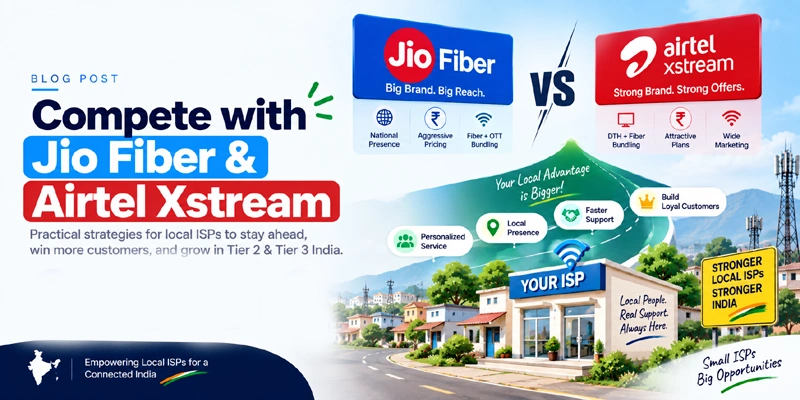
Where Local ISPs Actually Have an Edge
- Faster installation: A local technician can often get a new connection live in a day or two, compared to national providers where installation can take several days depending on serviceability and scheduling
- Personalized, faster support: Local technical teams operating nearby can resolve complaints faster than a centralized national support system handling millions of customers
- Better local network knowledge: Understanding your specific neighborhood's infrastructure quirks means fewer generic troubleshooting loops and faster real fixes
- Flexible, community-tailored plans: Pricing and plans that actually match local income levels and usage patterns, rather than a one-size-fits-all national plan
The trade-off is real too — local ISPs typically have smaller coverage areas and fewer bundled entertainment perks than national brands. Play to your actual strengths rather than trying to match theirs feature-for-feature.
Strategy 1: Compete on Speed of Service, Not Just Speed of Internet
Same-day or next-day installation and same-day complaint resolution are things a national provider's scale makes structurally difficult to match. Make this your loudest marketing message locally — it's one of the few areas where being small is a genuine advantage, not a limitation to apologize for.
Strategy 2: Bundle Smart, Not Broke
Some regional ISPs have responded to national competition by bundling OTT and IPTV content — sometimes even near cost — specifically to retain broadband subscribers who might otherwise be tempted by a bundled national plan. This can work, but only if the core broadband service and support stay reliable; a content bundle doesn't save a customer who's frustrated with basic service issues.
Strategy 3: Build Hyperlocal Trust
Being a known, visible presence in your service area — sponsoring a local event, having a technician customers recognize by name, responding personally when something goes wrong — builds a kind of loyalty a call-center-driven national brand structurally can't replicate. This matters more in smaller towns and specific neighborhoods than it does in anonymous metro high-rises.
Strategy 4: Fix the Operational Basics a Bigger Rival Can't Use Against You
Here's an uncomfortable truth: some customers who "leave for Jio or Airtel" actually left because of a billing mistake, a slow complaint resolution, or a wrongful disconnection — not because the competitor was genuinely better. These are entirely within your control:
- Accurate, automated billing so customers never get an unfair charge or wrongful disconnection
- Instant activation after payment, matching (or beating) what a national app-based provider offers
- A self-service portal so customers aren't stuck waiting on hold for basic questions
- GPS-tracked field collection so cash handling never becomes a customer dispute
None of this requires competing with a national marketing budget — it just requires not losing customers to your own preventable mistakes while you compete on the things that actually differentiate you.
Strategy 5: Take the Consolidation Risk Seriously
With roughly a third of ISP licenses already inactive, the market is thinning out. The ISPs surviving this shakeout tend to be the ones with tight operations, not just good local relationships — professional billing, reliable network uptime, and financial discipline matter as much as neighborhood goodwill when the market consolidates further.
How BrightCRM Supports This Competitive Strategy
BrightCRM helps small ISPs win on the operational side of this fight, so local goodwill isn't undermined by preventable mistakes:
- Automated billing that matches the instant, app-based experience customers now expect from any provider
- RADIUS-based auto-activation as fast as anything a national FWA provider offers
- Self-service portal and SMS/WhatsApp automation, so customer experience doesn't depend entirely on office hours
- Clean financial reporting to help you run the tight operation that survives market consolidation
Real-World Impact
Broadband ISP, Mysuru
"We stopped trying to match Jio's pricing and started advertising 'installed today, not next week.' That's what actually brought customers in."
Local ISP, Jodhpur
"A few customers we thought we'd lost to a national brand turned out to have left over a billing dispute. Fixing our billing process directly reduced that churn."
Conclusion: Compete Where the Fight Is Actually Winnable
You're not going to out-market Jio or Airtel, and trying to will drain resources you don't have to spare. But faster installation, better local support, and operations tight enough that you never lose a customer to your own mistakes — that's a fight small ISPs can genuinely win, one neighborhood at a time.
Ready to Compete on Service, Not Just Price?
See how BrightCRM gives your ISP the same instant, automated experience customers expect from the big brands.
Schedule Free Demo