The Gap Between "Collected" and "Deposited"
Many ISPs and cable operators still rely on field agents to visit customers, collect cash, and hand it over — or deposit it — at the end of the day. It works, until the numbers stop adding up. A customer insists they paid. Your agent says they weren't home. Your ledger shows a shortfall you can't quite trace to any single person or day.
This isn't always dishonesty — sometimes it's genuine confusion, lost receipts, or delayed deposits. But whether it's fraud or sloppy process, the result is the same: money that should be in your account isn't, and you have no way to prove where it went.
How Cash Leakage Actually Happens
- Partial reporting: An agent collects the full amount but reports and deposits less, pocketing the difference.
- Delayed deposits: Cash sits with the agent for days before reaching the office, creating float that's easy to "borrow" from temporarily — or never return.
- Fake "not home" visits: An agent marks a customer as unavailable while actually having collected payment, then either keeps the cash or collects it "again" later without recording the first visit.
- Ghost collections: Payments logged for visits that never actually happened, especially in areas the office can't easily verify.
- No way to verify any of it: Without location or time data, every dispute comes down to your word against your agent's — and against your customer's.
💡 The Real Problem
It's not that most field agents are dishonest — it's that a paper-and-cash system has zero built-in verification. Even honest mistakes look identical to fraud when there's no record of when and where a payment actually happened.
What GPS-Tracked Collection Actually Does
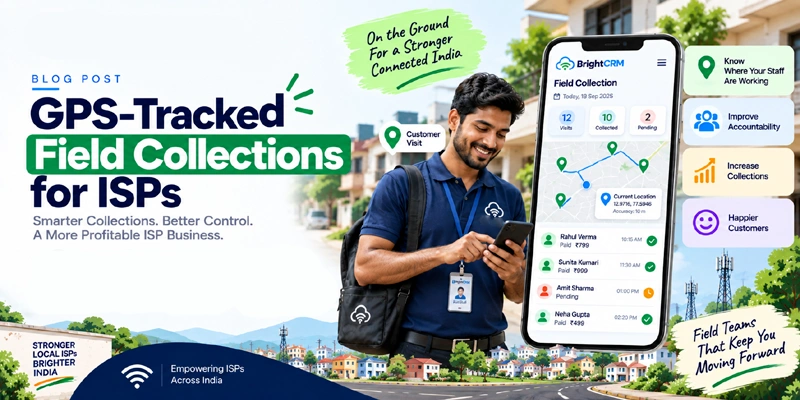
A GPS-tracked collection app removes the guesswork by recording exactly where and when each payment was collected, tied directly to the customer's account — not a notebook entry that can be edited or "lost" later.
How It Works, Step by Step
- The field agent logs into a mobile collection app assigned to their route for the day
- They open a customer's account and record the payment on the spot
- The app automatically captures the agent's GPS location at the moment of collection
- A digital receipt is generated instantly and sent to the customer via SMS/WhatsApp — so the customer has their own record too
- The payment syncs immediately to your central billing dashboard, visible to your office in real time, not at end of day
Because the customer gets an instant digital receipt the moment payment is recorded, any mismatch between what the customer says they paid and what's recorded shows up immediately — not weeks later during a reconciliation headache.
What to Look For in a Field Collection App
- Location capture at the point of collection — not just a login location for the day, but per-transaction GPS tagging
- Real-time sync to the central billing system, not end-of-day batch upload
- Instant customer receipts via SMS/WhatsApp so customers have independent proof of payment
- Route/visit history showing which customers were visited, when, and with what outcome (paid, not home, refused)
- Offline support for areas with poor network coverage, syncing automatically once connectivity returns
- Reconciliation reports comparing cash collected vs. cash deposited, by agent, by day
The Business Impact
📊 What Changes After Switching
ISPs that move from paper-based to GPS-tracked collection typically see collection-vs-deposit discrepancies drop sharply within the first billing cycle, simply because every transaction now has a verifiable time, location, and customer-side receipt attached to it.
Beyond fraud prevention, this also protects honest agents — a GPS-tagged, timestamped record clears up "he said, she said" disputes in their favor just as often as it catches genuine leakage. It's not just a control mechanism; it's fairer for your field team too.
How BrightCRM's Field Collection App Works
BrightCRM includes an Android app built specifically for ISP field staff:
- Agents see their assigned customers and outstanding dues for the day
- Every payment collected is GPS-tagged automatically — no extra step for the agent
- Customers receive an instant digital receipt the moment payment is recorded
- Payments sync to your central dashboard in real time, visible to office staff immediately
- Because it's connected to your billing system, a recorded payment can also trigger automatic internet reactivation the same way an online payment would
Real-World Impact
Cable Operator, Kanpur
"We finally stopped arguing with customers about who paid what. The GPS timestamp and digital receipt settle it in seconds."
Broadband ISP, Guwahati
"Cash discrepancies at month-end used to take days to investigate. Now every collection has a location and time attached — there's nothing left to investigate."
Conclusion: Trust, But Verify — Automatically
You don't need to assume the worst about your field team to want better visibility into where your money is at every point in the collection process. GPS-tracked collection isn't about suspicion — it's about replacing a system that has no record of what happened with one that has proof, for your business and your customers alike.
Ready to See Where Every Rupee Your Agents Collect Actually Goes?
See how BrightCRM's GPS-tracked collection app closes the gap between collected and deposited.
Schedule Free Demo