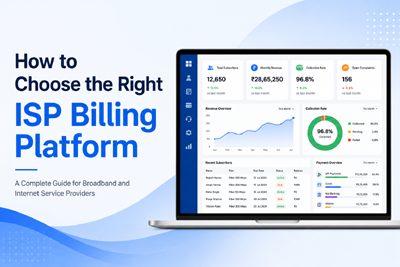
For an Internet Service Provider (ISP), the network infrastructure is the muscle, but the billing system is the heartbeat. Whether you are a local broadband operator in a tier-2 Indian city or a rapidly expanding regional fiber network business, how you manage your revenue dictates how fast you can grow.
Many ISPs start small, relying on a patchwork of Excel spreadsheets, disconnected accounting software, and manual cash collections. While this might work for the first 100 subscribers, it quickly turns into an administrative nightmare as you scale. Delayed payments, forgotten renewals, disconnected tracking, and manual invoice generation lead to severe revenue leakage and dissatisfied customers.
To transition from a struggling local operator to a profitable, automated enterprise, you need the right ISP CRM software. Selecting the perfect system is a critical business decision. This comprehensive guide will walk you through how to choose the right ISP billing platform, what features are non-negotiable, and how an all-in-one solution like BrightCRM can transform your operations.
What Is an ISP Billing Platform?
An Internet service provider billing system is a specialized software solution designed specifically for the unique recurring billing, networking, and customer lifecycle needs of internet and broadband providers.
While generic accounting software (like Tally or QuickBooks) is great for basic bookkeeping, it falls short for ISPs. Generic software cannot talk to your network hardware, automatically suspend a user's internet connection for non-payment, or handle complex prepaid and postpaid bandwidth plans.
A modern ISP management software acts as a centralized command center. It handles daily operations such as:
- Automatically generating monthly subscriber invoices.
- Authenticating users and managing data limits via RADIUS servers.
- Dispatching automated payment reminders via WhatsApp or SMS.
- Tracking technician locations and complaint ticket resolutions.
Why Choosing the Right ISP Billing Platform Matters
Your choice of broadband billing software directly impacts your bottom line. Relying on the wrong software—or worse, no software at all—creates billing errors, unresolved customer complaints, and untracked revenue leakage. Here is why making the right choice matters:
- Revenue Management: Automated systems ensure every megabyte of data provided is billed and collected, minimizing revenue leakage from inactive but unpaid connections.
- Customer Satisfaction: Customers expect seamless digital experiences. The ability to pay via UPI at 11:00 PM and have their internet instantly reactivated keeps customers happy and reduces churn.
- Automation: By removing manual data entry, your staff can focus on acquiring new customers rather than chasing down old invoices.
- Operational Efficiency: Field technicians, collection agents, and network admins can all operate from a single source of truth, eliminating miscommunication.
- Business Scalability: A robust system seamlessly handles the jump from 500 subscribers to 5,000 without requiring you to quadruple your back-office staff.
Key Challenges Faced by ISPs Using Outdated Billing Systems
When ISPs attempt to manage growing networks with outdated tools, the cracks show quickly. Common pain points include:
- Manual Invoice Generation: Generating and mailing hundreds of invoices manually takes days and is prone to human error.
- Excel-Based Subscriber Tracking: Tracking MAC addresses, IP assignments, and plan expiries in spreadsheets inevitably leads to mismatched data and unauthorized access.
- Delayed Payment Collections: Without automated reminders and digital payment gateways, operators rely on manual field collections, delaying cash flow and increasing the risk of theft.
- Poor Reporting: Operators cannot easily calculate their Average Revenue Per User (ARPU) or identify which geographic areas have the highest customer churn.
- Limited Automation: If a customer pays late at night, an administrator still has to wake up and manually reactivate their connection the next morning.
- Customer Support Inefficiencies: Without a centralized CRM, support agents have no context on a caller's past complaints or current network status, leading to frustrating phone calls.
- Data Security Concerns: Keeping sensitive subscriber data (KYC documents) in unencrypted local folders poses a massive risk of data loss and regulatory non-compliance.
Essential Features to Look for in an ISP Billing Platform
When evaluating the best ISP billing software in India, look beyond basic invoicing. The platform must act as a complete ISP business management software. Here are the critical features to demand.
Subscriber Management
A 360-degree view of your customers is essential. Your software should provide detailed customer profiles that include personal details, current plan management, complete service history, hardware deployment details (like ONT/Router serial numbers), due tracking, and real-time connection status monitoring.
Automated Billing and Invoicing
Your platform must support the complex billing cycles of an ISP. Look for capabilities like recurring invoices, bulk billing generation, and flexible scheduled billing cycles (monthly, quarterly, annual). For Indian ISPs, built-in GST invoices are an absolute necessity to remain compliant with tax regulations.
Online Payment Integration
India runs on digital payments. Your broadband CRM software must support native online payment integration so customers can pay seamlessly. Ensure it supports UPI, Credit cards, Debit cards, Net Banking, and Digital wallets. Crucially, the system must offer instant payment confirmation that automatically updates the ledger and reactivates suspended accounts without human intervention.
Payment Collection Management
For cash and cheque collections, the software must provide robust collection tracking. A dedicated field collection app allows agents to log payments on the go and print Bluetooth receipts. The system should also automate payment reminders (via SMS, email, and WhatsApp) and provide detailed collection analytics to track agent performance.
Complaint and Ticket Management
Downtime happens, but poor service shouldn't. An integrated ticketing system ensures smooth complaint handling. It must include ticket creation, automatic technician assignment based on locality, Service Level Agreement (SLA) tracking to ensure timely fixes, and resolution monitoring.
CAF Management
Customer Application Forms (CAF) are a regulatory requirement. The platform must offer digital CAF management, allowing for paperless onboarding. Look for features like digital customer application forms, easy document uploads, KYC verification tracking, and a streamlined approval workflow to activate new connections faster.
RADIUS Integration
This is the bridge between your billing software and your network hardware. Deep compatibility with major network access servers is non-negotiable. Ensure the software integrates with systems like MikroTik, H8, IPACCT, Jaze, or OneRadius. Key features should include auto-activation upon payment, auto-suspension upon expiry, and real-time synchronization of bandwidth limits and data usage.
Customer Self-Service Portal
Empower your subscribers to manage their own accounts. A customer self-service portal (accessible via web or mobile app) should allow users to easily pay bills, view historical invoices, track complaint statuses, and update their contact information, vastly reducing the burden on your call center.
Reporting and Analytics
Data drives growth. Ensure your platform offers advanced performance dashboards. You need instant access to revenue reports, collection reports, subscriber growth trends, and churn analysis to make informed business decisions.
Questions Every ISP Should Ask Before Buying Billing Software
Do not sign a contract until you have asked the vendor these crucial questions:
- Is the software built specifically for ISPs, or is it a generic CRM?
- Can it scale seamlessly as my subscriber base grows from hundreds to thousands?
- Does it natively support Indian online payment gateways (like Razorpay, PayU, or direct UPI)?
- Does it integrate flawlessly with my existing RADIUS server and routers?
- Is there a dedicated mobile collection and technician app for my field staff?
- How secure is customer data, and are KYC documents safely encrypted?
- What kind of local customer support and training options are available?
- Will the vendor assist me in migrating my existing subscriber data from Excel?
Cloud-Based vs On-Premise ISP Billing Platforms
Historically, operators installed software on local servers in their offices. Today, the industry is shifting to cloud-based solutions. Here is why:
| Feature | Cloud-Based Platform | On-Premise Software |
|---|---|---|
| Cost | Low upfront cost (Subscription) | High upfront hardware & license costs |
| Maintenance | Handled by the vendor | Requires an in-house IT team |
| Security | Enterprise-grade encryption & backups | Vulnerable to local hardware failure |
| Accessibility | Access anywhere via internet | Restricted to the local office network |
| Scalability | Instant, unlimited scaling | Requires buying and installing new servers |
| Updates | Automatic, seamless updates | Manual, often disruptive updates |
Cloud-based solutions provide peace of mind, allowing you to focus on expanding your fiber network rather than maintaining local servers.
Common Mistakes to Avoid When Choosing ISP Billing Software
When hunting for an automated ISP billing system, avoid these common pitfalls:
- Choosing based only on price: Free or heavily discounted software often lacks critical features, security, or support. It will cost you more in lost revenue over time.
- Ignoring integration capabilities: If the software cannot talk to your Mikrotik routers or payment gateways, it is useless.
- Overlooking customer support: When your billing server crashes on the 1st of the month, you need a vendor who answers the phone immediately.
- Lack of scalability planning: Buying a system capped at 1,000 users will cripple your growth.
- Not evaluating automation features: If you still have to manually click a button to suspend defaulters, it isn't true automation.
- Skipping data migration planning: Ensure the vendor has a clear plan to import your messy Excel data into the new system cleanly.
How BrightCRM Helps ISPs Manage Their Entire Business
If you are looking for an ISP automation platform built specifically for the demands of the Indian market, BrightCRM is designed to centralize your entire operation into one powerful, easy-to-use cloud platform.
Here is how BrightCRM acts as the ultimate growth partner for broadband operators:
- Subscriber Management: Get a bird's-eye view of every user on your network, their hardware, and connection health.
- Billing Automation: Say goodbye to manual invoicing. Set billing cycles and let the system handle the rest.
- Payment Gateway Integration: Collect payments instantly via UPI, Cards, and Net Banking, reducing outstanding dues.
- CAF Management: Maintain 100% DoT compliance with digital KYC document storage and easy retrieval.
- Complaint Management: Route tickets efficiently to field engineers and track resolution times.
- RADIUS Integration: Seamlessly sync with MikroTik and other leading servers to auto-suspend and auto-activate connections based on payment status.
- Mobile Collection App: Empower your field agents to collect payments safely and log them in real-time.
- Customer Self-Service Portal: Give your users an intuitive dashboard to manage their subscriptions.
- WhatsApp Reminders: Drastically improve collection speeds with automated, friendly WhatsApp payment nudges.
- GST-Compliant Invoicing: Generate perfect, tax-compliant invoices with zero manual calculations.
- Advanced Reporting: Understand your revenue, ARPU, and churn rates at a glance.
By utilizing BrightCRM, operators eliminate the chaos of multiple disconnected tools, reducing overhead costs and freeing up capital to lay more fiber.
Case Example – Growing from 500 to 5,000 Subscribers
Consider Bharat Broadband, a fictional fiber provider in Maharashtra.
The Challenge: At 500 subscribers, the owner managed everything on Excel. But as demand surged, chaos ensued. They lost track of renewals, technicians were overwhelmed with duplicate support calls, and field agents were hoarding cash collections for days. Revenue leakage hit 15%, and growth stalled.
The Solution: Bharat Broadband adopted a modern ISP CRM software (like BrightCRM). They migrated their data, integrated their MikroTik routers, and enabled UPI payments via a customer portal.
The Result: Operational improvements were immediate.
- Faster collections: WhatsApp reminders and instant UPI links reduced overdue payments by 80%.
- Better customer satisfaction: Customers loved the instant night-time auto-reactivations.
- Business growth: With back-office chaos eliminated, the owner focused entirely on expansion. Within two years, Bharat Broadband scaled effortlessly to 5,000 subscribers with the exact same back-office headcount.
Checklist for Choosing the Right ISP Billing Platform
Keep this checklist handy when evaluating your next software provider:
- Billing Automation: Does it handle recurring, bulk, and prorated billing?
- CRM Features: Does it offer a complete 360-degree customer view?
- Online Payments: Are local Indian payment gateways natively integrated?
- RADIUS Support: Is auto-suspension and auto-activation supported?
- Mobile App: Is there an app for field technicians and collection agents?
- Reporting: Can I generate real-time ARPU and churn analytics?
- Security: Are CAF and KYC documents stored securely in the cloud?
- Customer Support: Is the vendor's support team responsive and knowledgeable?
- Scalability: Can the system comfortably handle 10x my current subscriber base?
Conclusion
Your billing system is not just a bookkeeping tool; it is a strategic investment in the future of your ISP business. Relying on outdated methods stifles your growth, leaks revenue, and frustrates your customers.
By prioritizing the key features outlined in this guide—such as RADIUS integration, digital CAF management, automated invoicing, and robust online payment support—you can select an Internet service provider billing system that actually works for you, rather than you working for it.
Ready to stop managing spreadsheets and start scaling your network? Discover how BrightCRM can automate your billing, streamline your collections, and delight your subscribers.
Ready to Take the First Step?
Schedule a free BrightCRM demo today and take the first step toward a more profitable ISP business!
Schedule Free Demo